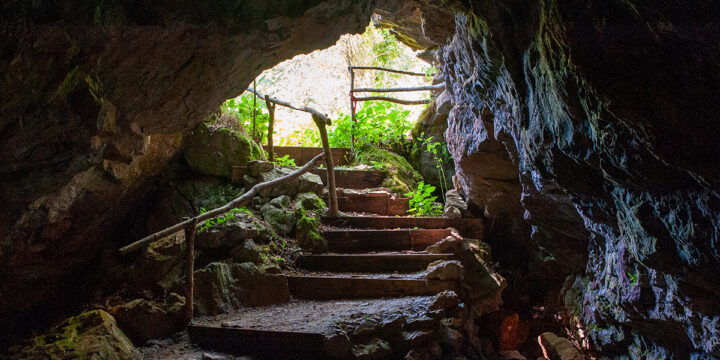
Russian Cave / Ruska Jama

Russian Cave / Ruska Jama

Portfolio
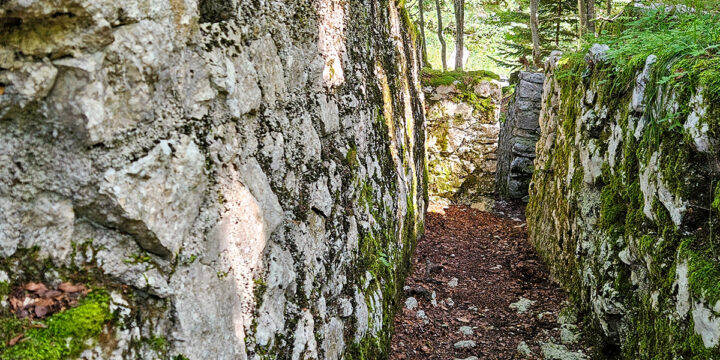
  Russian Cave / Ruska Jama There is a multitude of natural karst caves in the area of the Kras. During the time of the Isonzo Front (1915-1917) several of them were arranged by the caving-and-constuction detachment of the Corps VII of the Austro- Hungarian Army to serve military purposes. One of the caves that was initially used for ammunition storage was subsequently called the Russian Cave, because later on, the Russian POWs were lodged in it. They had to live there in unbearable conditions. According to the estimation of historians, about 40.000 Russian POWs captured on the Eastern Front, were present during the First World War on the territory of present-day Slovenia. About 15.000-20.000 of them were confined on the broader area of the Kras. The forced labour of…
Read More
Dolina dei 500

Dolina dei 500

Outdoor Museums, Portfolio, ProgramDay1
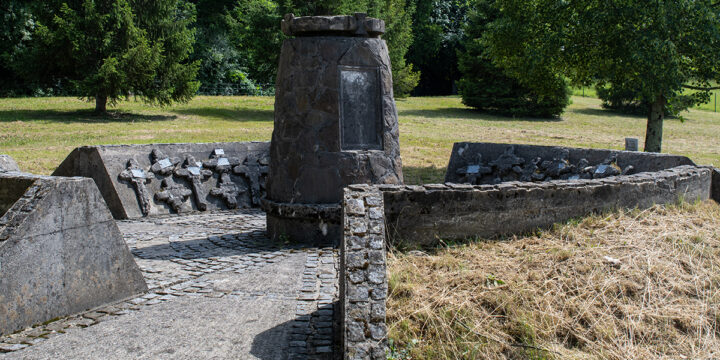
  Dolina dei 500 The major part of the outdoor museum is taken up by the Dolina del XV Bersaglieri. It is a karst valley or doline between Hill 86 (The Redipuglia Charnel House) and Hill 117 (Monte Sei Busi). The museum area encompasses part of the fortified trenches which ran from Monfalcone/Tržič to Monte San Michele/Debela griža and provided defence of the karst edge during the initial battles along the Isonzo (Soča). The doline got this name because a marking was found here with the symbol of the Bersaglieri Battalion. However, it is also known under the name of Dolina dei Cinquecento (Doline of the Five Hundred), because a collective tomb was discovered here, with five hundred corpses of fallen soldiers who were later disinterred and reburied in the…
Read More
Charnel House (German) Nemška kostnica

Charnel House (German) Nemška kostnica

Portfolio
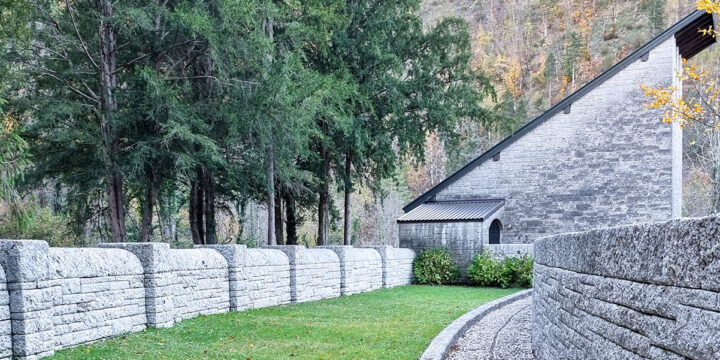
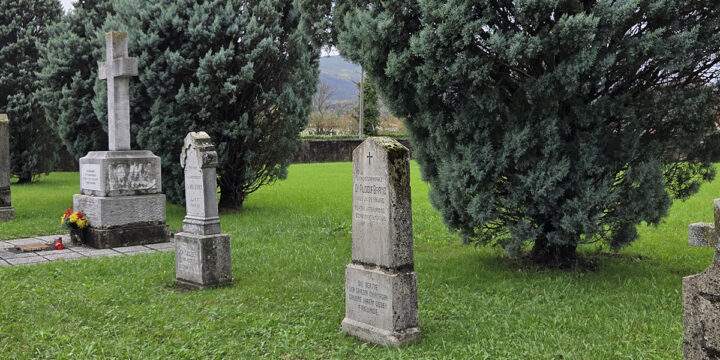
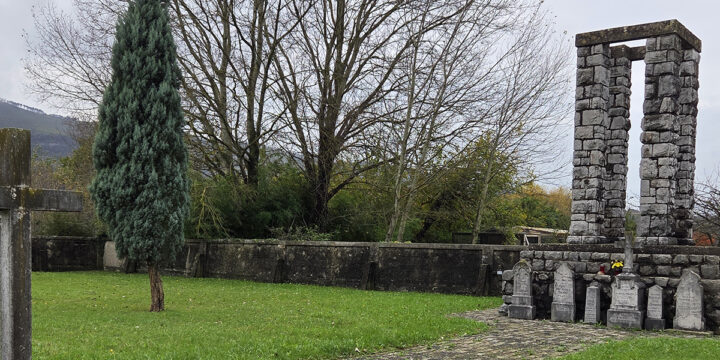
  Charnel House (German) Nemška kostnica Tolmin In the years 1936–1938 the German state built a charnel house on the location of the former military cemetery with 931 graves. The building received mortal remains of about 1,000 German soldiers who were killed on the battlefields along the Soča in the Twelfth Isonzo Battle. The building materials for the construction of this significant cultural-historical and architectural monument were transported from South Tyrol. The work was done by a German building company from Munich. The charnel house is enclosed with a stone wall and is accessible through an iron gate, made of Austrian and Italian barrels. It is constructed of stone blocks, has a steep pent roof, and a porch from which the entrance leads into the central part of the monument,…
Read More
Austro-Hungarian military cemetery WW1, Ajševica

Austro-Hungarian military cemetery WW1, Ajševica

Portfolio
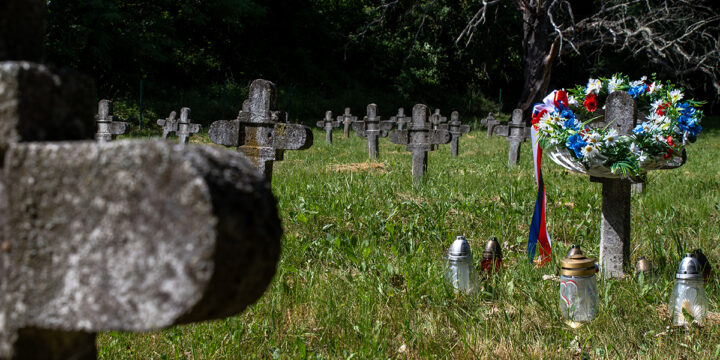
  Austro-Hungarian military cemetery WW1, Ajševica The Austro-Hungarian military cemetery Ajševica lies east of the hamlet Parkovšče. Buried in it are soldiers who fought in the areas of Panovec, Rožna Dolina and Markov hrib. These units were parts of the 58th Infantry Division. According to the data of Italian authorities that organized exhumation of soldiers from military cemeteries in the 1930s, 1,265 soldiers are buried here. The cemetery was arranged in the 1980s. Preserved are only a few headstones, two bigger grave memorials, and the central monument on which a bigger wooden cross was formerly mounted. Source: The Walk of Peace   June 2022 [gallery type="square" link="file" size="full" ids="3336,3334,3335,3337,3338,3339,3340,3341,3342,3343,3344,3345,3346,3347"]
Read More
Austro-Hungarian military cemetery WW1, Volčja Draga

Austro-Hungarian military cemetery WW1, Volčja Draga

Portfolio
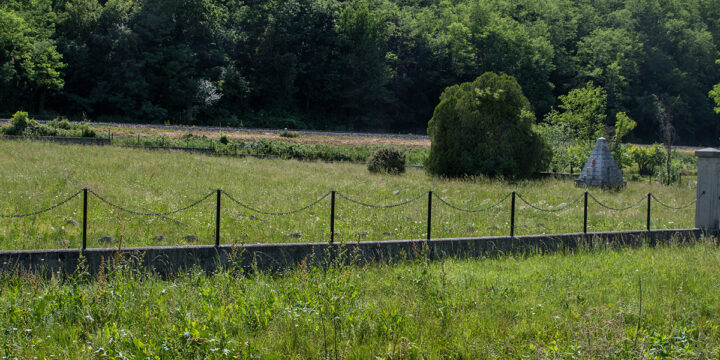
  Austro-Hungarian military cemetery WW1, Volčja Draga Buried in the Austro-Hungarian military cemetery in Volčja Draga are mainly soldiers of the 76th Infantry Regiment of Sopron (Hungary). The central monument in the shape of a pyramid was erected to their memory and bears the mark of the regiment, i.e. IR76, and two inscriptions, one in Hungarian, “Szeretetünk hálánk jeléül“ (As a sign of our love and gratitude), another in German “Euch Ihr Helden in Dankbarkeit” (To our heroes with gratitude). Most of these soldiers fell during the Tenth and Eleventh Isonzo Battles which took place in the vicinity (Vrtojba‒Bilje hills). The original war cemetery was much smaller, but after the war the Italian authorities transferred mortal remains of soldiers from nearby minor cemeteries to this cemetery as well. According to…
Read More
Austro-Hungarian military cemetery WW1, Log pod Mangartom

Austro-Hungarian military cemetery WW1, Log pod Mangartom

Portfolio
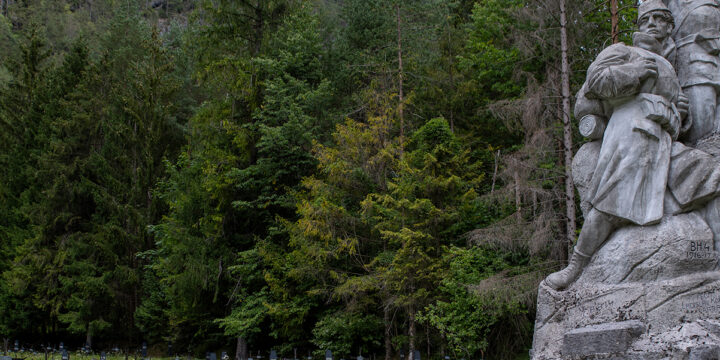
  Austro-Hungarian military cemetery Log pod Mangartom The Austro-Hungarian cemetery from World War I is one of the best preserved military cemeteries in Slovenia of that time. The valley of the Koritnica was sufficiently remote from the direct fights, so that the cemetery was arranged already in the first year of the war. The most numerous are the graves of the soldiers of the 4th Bosnian-Herzegovinian Infantry Regiment (BHIR 4). Today, all the graves are marked with crosses or nišans, the typical Muslim headstones, all furnished with tablets inscribed with the names of the killed soldiers. In the centre of the cemetery stands a colossal monument, a work by Ladislav Kofránek of Prague, which was already erected during the war and dedicated to the defenders of Mt. Rombon. It features…
Read More
Zaprikraj Outdoor Museum

Zaprikraj Outdoor Museum

Portfolio
  Zaprikraj Outdoor Museum The outdoor museum Zaprikraj lies between the alpine pastures of Predolina and Zaprikraj. It is located along the Italian first line of defense. The circular path runs past well preserved and partly reconstructed positions of the Italian Army. It leads through trenches, caves, gun- and mortar positions, and past the remains of cabins. When Italy declared war on Austria-Hungary, the latter decided to transfer its defense from the then state border to the mountain ridges on the left bank of the Soča (Isonzo). At the beginning of the war, the Italians were quite successful in the mountains above Drežnica, since they conquered a large portion of the western ridges of the Krn range, and on 16 June 1915 also the peak of Mt. Krn itself. The…
Read More
Austro-Hungarian military cemetery WW1, Renče–Lukežiči

Austro-Hungarian military cemetery WW1, Renče–Lukežiči

Portfolio
  Austro-Hungarian military cemetery WW1, Renče–Lukežiči The Austro-Hungarian military cemetery Renče–Lukežiči adjoins the civil cemetery. Buried there are the Austro-Hungarian soldiers who died in the nearby military hospital, set up in Renče Castle. During World War I, 1,205 soldiers were buried in this cemetery: 1,179 Austro-Hungarian, 21 Italian, and one German soldier, two Russian and two Serbian POWs. After the war the Italian military authorities transferred the remains of soldiers from the nearby cemeteries to this cemetery. All the fallen Italian soldiers were transferred to the Italian charnel house in Oslavia/Oslavje. According to the official records, 1,599 lie here now. 428 of whom are unknown (400 of them are buried in a common tomb). Most of the known soldiers belonged to the Magyar Kirdlyi Honvéd (Royal Hungarian Honvéd) 17th, 3rd,…
Read More
Austro-Hungarian military cemetery WW1, Bukovica

Austro-Hungarian military cemetery WW1, Bukovica

Portfolio
  Austro-Hungarian military cemetery WW1, Bukovica Buried in the cemetery are 282 Austro-Hungarian soldiers, members of the Infantry Regiment no. 24, who fell in the First World War in the area of Dolnja Vitojba. Among them are also several tens of soldiers from the Home Guard Infantry Regiment no. 2 (Landwehrinfanteriereginment Linz No. 2) of Linz,Austria. The conscript area for the Infantry Regiment no. 24 (K.u.K. Infanterieregiment “Ritter von Kummer” No. 24) was in the district of Kolomea (now Kolomyia), present Ukraine. The regiment consisted of 80% of Ruthenes (Rusyns), 10% of Poles, and 10% of Germans. From September through October 1916, they fought within the scope of the 59th Infantry Brigade (59. Infanteriebrigade) in the 7th, 8th and 9th Isonzo Battles in the area between Dolnja Vrtojba and the…
Read More
Austro-Hungarian military cemetery WW1, Renče- Žigoni

Austro-Hungarian military cemetery WW1, Renče- Žigoni

Portfolio
Austro-Hungarian military cemetery WW1, Renče- Žigoni   The Austro-Hungarian military cemetery is situated close to the road between Renče and Žigoni. Most of the buried deceased in the nearby military hospital, where they treated infectious diseases (Epidemiespital). According to the data of Italian authorities, which in the 1930s lead the organization of military cemeteries, 704 people are buried here (370 of whom are unknown), among them also many civilians, evidence of which is a tombstone to Doroteja Cotič of Dornberk. The known soldiers mainly belonged to the K.u.K. Infanterieregiment N°46, (Imperial and Royal Infantry Regiment N°46), from the conscript area of Szeged in Hungary, and from different working units. Most of the unknown soldiers were transferred to this cemetery from other cemeteries near Renče and Špacapani. Behind the central monument,…
Read More